Stop Paying the Office Drone Tax: Why "Weird" Teams Ship Better Code
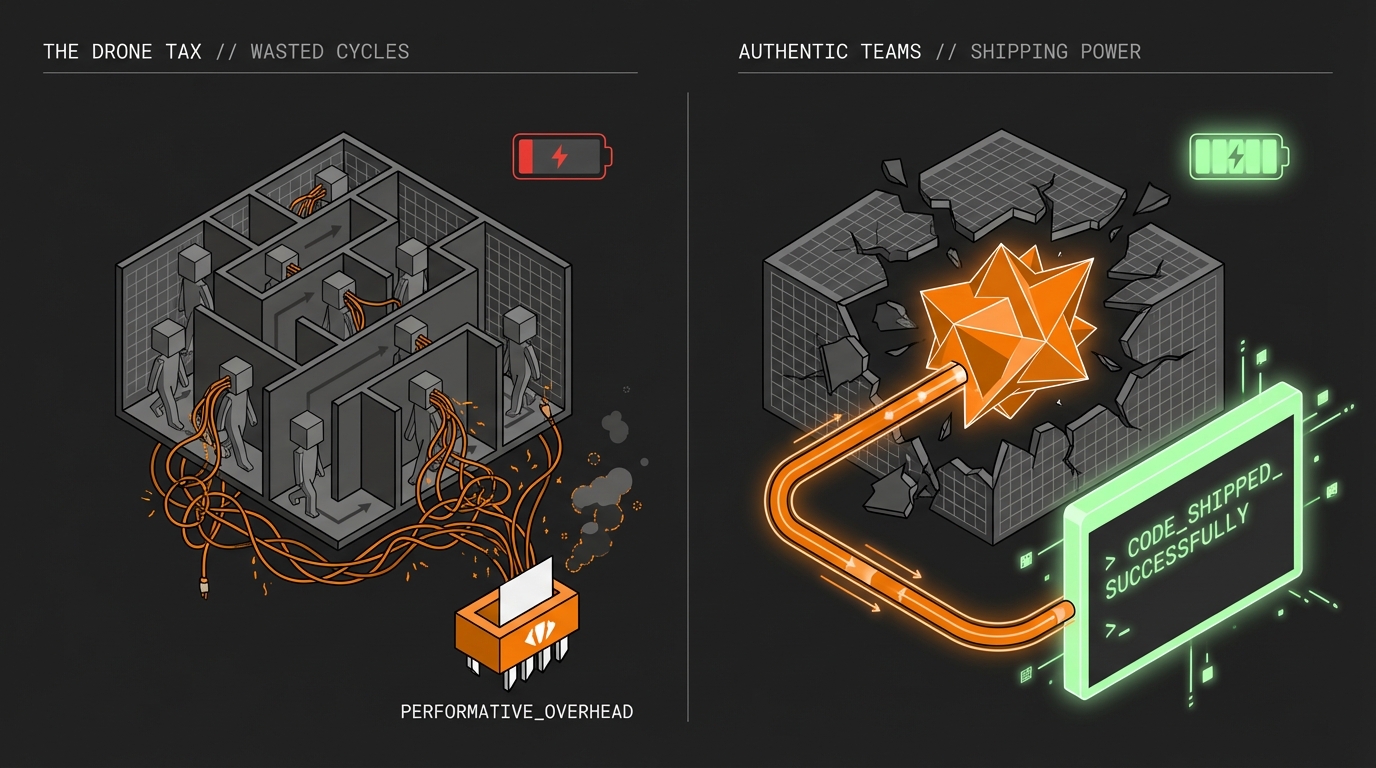
TL;DR: If your engineers burn mental cycles second-guessing their every move to fit corporate norms, they aren’t solving your hardest technical problems. Psychological safety isn't a "soft skill"—it's a performance optimization. By letting people be their authentic, "weird" selves, you reclaim wasted energy and plow it back into shipping better software.
If you’re forcing your employees to behave like office drones, you are literally burning cash.
We talk about performance in terms of latency, throughput, and "n+1" queries, but the biggest resource leak in your company isn't in your code—it's in your culture. It’s the "Office Drone Tax." Every time an engineer sits in a meeting thinking, "Can I say this thing? I'm not sure... should I do this? Is it 'professional' enough?" you are losing the very mental energy you’re paying them for.
Why is my team of "professionals" shipping such mediocre code?
Because you've built an environment where "professionalism" is a performance rather than a result. When devs are afraid to look weird or wacky, they spend half their brainpower on second-guessing themselves instead of plowing that effort into your business.
Think of your team’s collective brainpower as a finite pool of energy. In a low-safety, "drone-style" office, that energy is constantly drained by background processes: self-monitoring, wondering if they can ask a specific question, and trying to act "normal." It’s a massive resource leak.
When you allow people to bring their "home selves" to work—and let’s be honest, people are weird, wacky, and wonderful—you kill those background processes. You reclaim that energy. Instead of a developer spending three hours trying to word an email so they don't look "difficult," they spend three hours solving a problem you haven’t even realized you have yet.
How do "dumb" questions actually save us money?
A "dumb" question is usually the one that exposes a fundamental, multi-million dollar architectural flaw that everyone else was too embarrassed to point out. If your team is too "professional" to ask stupid questions, they are too "professional" to catch disasters early.
The trick to making a truly high-performing team is getting everyone to a point where they can ask the obvious stuff without fear. When people feel safe being their authentic selves, they don't mind looking "stupid" for five minutes to save the company six months of wasted work.
They’ll ask things like, "Wait, why are we even building this custom auth service when we only have three users?" or "Does this feature actually solve the user's problem, or are we just checking a box?" That is the energy you want—raw, honest, and focused on the business, not the optics.
The Real Cost of the Drone Tax
The "Office Drone" (Low Safety) | The Authentic Engineer (High Safety) |
|---|---|
Nodding along to a disaster-tier architecture because nobody wants to look "difficult." | Asking the "stupid" question that kills a 6-month waste of time in 5 minutes. |
Over-engineering a simple fix into a 10-class "Enterprise" pattern just to look smart. | Shipping a 5-line script that actually works because they don't need to prove anything. |
Spending 2 hours drafting a 3-line Slack message to sound "corporate." | Plowing that energy directly into fixing a production-blocking bug. |
Hiding a "dumb" mistake until it becomes a catastrophic, multi-day outage. | Admitting a mistake early so the team can fix it in seconds and move on. |
What does "drone" code look like vs. "authentic" code?
Drone code is performative; it’s written to look "Senior" and "Enterprise" to avoid criticism. Authentic code is honest; it’s written to solve the problem as simply as possible, even if the solution looks "weird" or unpolished.
Think about the typical "office drone" approach where a developer writes 50 lines of performative boilerplate because they’re afraid a simpler solution will make them look like they don’t know what they’re doing.
// THE DRONE WAY: Over-engineered to look "Professional"
// Afraid to just use a simple map because it looks too "basic"
class UserStatusManager {
  constructor(statusMapping) {
    this.mapping = statusMapping;
  }
  getStatusFromCode(code) {
    if (Object.prototype.hasOwnProperty.call(this.mapping, code)) {
      return this.mapping[code];
    }
    return 'UNKNOWN_STATUS';
  }
}

// THE AUTHENTIC WAY: Solving the problem and moving on
const STATUSES = { 1: 'Active', 2: 'Pending' };
const getStatus = (code) => STATUSES[code] || 'Unknown';
The second example is what happens when someone isn't worried about looking "Enterprisey." They just ship the fix and get back to the real work.
FAQ
Doesn't "authenticity" just lead to a lack of discipline? No, it leads to a lack of pretense. You can be the weirdest person in the world and still write the most disciplined, bulletproof code on the planet. In fact, if you aren't wasting energy acting like a drone, you have more discipline left for your unit tests.
How do I tell if my team is paying the "Drone Tax"? Watch your meetings. Is everyone nodding? Does everyone use the same corporate jargon? If nobody has asked a "dumb" question or proposed a "weird" idea in a month, you aren't being professional—you’re being robbed of your team's best ideas.
Is this just about being "nice" to people? It’s not about being nice; it’s about being profitable. A team that feels safe to be their wacky, wonderful selves is a team that has 100% of its cognitive capacity available to solve your business problems. Anything less is just a resource leak.
Cheers, Doogal


